
- Article
- September 7, 2026
Three Technology Shifts Transforming Business PCs: How the New Lenovo ThinkPad Lineup Responds

The expectations placed on business PCs are changing. Greater performance alone is no longer enough – increasingly important considerations include where and how artificial intelligence operates, how much energy it consumes, whether a device can be easily upgraded and repaired, and how long it can remain suitable for everyday work.
The new 2026 Lenovo ThinkPad generation has been designed around these changes. It highlights three major technology trends: on-device artificial intelligence, more durable and upgradeable hardware, and the performance and efficiency gains delivered by next-generation processors.
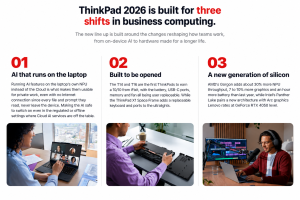
Artificial Intelligence Moves onto the Device
One of the most significant shifts is that AI features increasingly no longer require a constant connection to the cloud. In the latest ThinkPad PCs, some AI workloads are handled by a dedicated NPU – a neural processing unit.
This matters for more than performance. When AI processing takes place directly on the device, files and queries can remain on the PC, while certain features can continue to operate without an internet connection. This makes on-device AI particularly relevant when working with confidential information or in environments where cloud-based AI services are unavailable.
A dedicated NPU can also use energy more efficiently. In Lenovo’s comparison of the same local AI workload, the NPU consumes 5 W, compared with 65 W for the CPU and 120 W for the GPU. As a result, features such as live captions, translation and camera effects can run without placing additional load on the main processor or graphics chip, while consuming less battery power.
All ThinkPad models in the new lineup are Copilot+ PCs running Windows 11 Pro. The NPU enables Windows 11 AI features to run directly on the device, including Windows Studio Effects, enhanced Windows Search that can find files based on their content, and Live Captions with real-time translation.
Longevity Through Repairability and Upgradability
Another emerging technology trend is less about what a new computer can do today and more about how long it can remain in use.
The ThinkPad T14 and T16 are the first ThinkPad PCs to receive iFixit’s highest repairability score of 10 out of 10. Their batteries, USB-C ports, LPCAMM2 memory and fans can be removed using standard tools.
The replaceable LPCAMM2 memory used in the T14 and T16 also makes it possible to upgrade the devices later rather than replace the entire computer as requirements change. It reaches speeds of 7,467 MT/s, compared with 5,600 MT/s for DDR5 SO-DIMM memory. The other models introduced in the 2026 lineup use soldered memory.
A different approach to internal design is also used in the flagship ThinkPad X1 models. The new Space Frame design reduces the motherboard footprint by 20% and creates room for a 70% larger cooling system. The keyboard and USB-C ports in these models are also replaceable.
This approach changes the device lifecycle itself: the computer is designed not only to meet today’s requirements, but also with future repairability and upgrades in mind.
Next-Generation Processors: More Than Just Greater Speed
The third shift is taking place inside the computer. New processor architectures need to deliver greater overall performance, faster on-device AI processing and improved graphics capabilities, while using energy more efficiently.
Models in the 2026 ThinkPad lineup are available with Intel Panther Lake or AMD Gorgon platforms.
AMD Gorgon delivers approximately 30% higher NPU performance, 7–10% better graphics performance and around one additional hour of battery life compared with the previous generation. Intel Core Ultra Series 3, meanwhile, introduces a new architecture and H-series Arc graphics designed for more demanding creative and engineering workloads.
This reflects a broader shift: performance in business PCs is increasingly about more than simply having a more powerful main processor. What matters is how effectively the CPU, GPU and NPU can divide different workloads and process each one using the component best suited to the task.
A New ThinkPad Generation for Different Ways of Working
All three trends come together across the new ThinkPad portfolio – from the mobile X1 family and versatile T-series models to the performance-focused X9 flagship.
ThinkPad construction and design are evolving as well, while retaining the elements that have defined the product family for years, including its work-focused keyboard.
The most important change, however, goes beyond individual models or specifications. The new ThinkPad generation reflects a broader evolution in business computing: AI is moving onto the device, performance is increasingly being balanced with energy efficiency, and repairability and upgradability are becoming an important part of a device’s overall value.
As a result, choosing a next-generation business PC increasingly means considering not only the performance it delivers today, but also how well the technology will adapt to changing workplace needs in the future.